Khiram, the village of Nabi (PBUH)

By Tanveer ul Islam
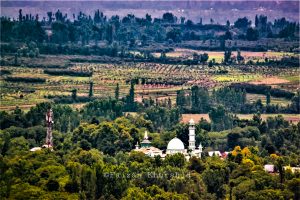
It was a hot summer day of Jun 1990 in Pandit Mohalla of Sirhama, a young lady was standing on the road near temple with a bag of dry rice in her hands. As the day was Friday, She was asking each passerby whether he or she is going to “Nabi Saebun” , please take my offering and present it at Dargah. This was every Friday,s routine for the lady. By ” Nabi Saeb” she means the famous Dargah Hazratbal at Khiram . Yes, the devotees from surrounding areas will not call this village by its name ” Khiram” but rather would take it as ” Nabi Saebun”. Khiram is the last village of Anantnag district towards North West . Located at a distance of 18 KM from Bijbihara and 25 KM from district headquarters of Anantnag. The village is situated at the boundary line of districts of Pulwama and Anantnag as Shikargah and Paner villages in Tral lies on the other side of the Khiram mountain.Stretched under the couch of a dwarf but desnsly forested branch of Pirpanchal range, Khiram ,the abode to holy hair of Prophet Mohammed (PBUH) is a historically important village of Kashmir . The village of Sirhama lies to its western side and hamlet of Novshera is situated to its south . On the eastern side of mountain of Khiram are hamlets of ” Haamnaer” and “Liver” in Sallar block and on Northern side are tiny villages of Shikargah and Paner in Tral Tehsil of Pulwama district. The location of Khiram is thus very strategic and geographically very important. The ” Panar” top is the place which recieves first spell of snowfall in the area and also the heaviest. The rain begins from this spot and then spreads to surroundings areas. During wet winters and rainy season, this mountain peak is always clad with thick fog and clouds. The village is comprised of mainly three big mohallas of Durpora, Khudpora and Degjipora. The lower part is known as Astanpora. The Bhats dominate the entire village, however Lone, Shah, Rather, Wani, Waggay, Shergojri and Telis are also found. Lone Dynasty dominates the Durpora.A few Pandits reside in village but they all migrated in 1990. Master Jawaharlal Bhat and Master Omkar Nath were some notable Pandits of Khiram. Now a days Khiram like all other modern villages have spread by leaps and bounds especially towards Noveshera, Sirhama and towards mountains. Khiram is second populous village after Marhama in erstwhile Bijbihara Tehsil. The village is home to 9160 people, among them 4742 (52%) are male and 4418 (48%) are female. 83% of the whole population are from general caste and 17% (1609) are schedule tribes (Gujjars) as per the census of 2011. The literacy rate is 52%. The approximate total area of the village is 14 square kilometres. The density of population is 647 per Sq KM. The creation of new adminstrative units in 2015 has placed Khiram under newly carved sub division of Pahalgam and in newly created Tehsil of Srigufwara. Khiram itself was established as a new revenue”Nayabat” under new arrangement.
The mountain of Khiram is widest but dwarf among neighbouring mountains of Noveshera and Sirhama. If we look closely ,the same range is expanded northwards to Tral, Ladhu ,Khriv in Pampore and then Zevan, Badamibagh ,Zabarvan and Harwan mountain in Srinagar. When one descends down from Cheeni vidder , Kandipora pleatue or Marhama vidder towards plains, the mighty snow capped mountains of Pahalgam are visible behind the Khiram mountain. These High mountains are home to several glaciers and frozen lakes like Tarsar, Marsar and Kolahigh . The level of these glaciers and Khiram mountain is almost parallel . Thus, mountain of Khiram is not only full of vegetation and dense forests of Pine and Cedar but there are a number of pernneial water springs sprouting out of the mountain. Khiram mountains are home to nearly 1609 Gujjar people,who lives in the Hamlets of Galan, Kacznaad, Panar and Sangnaad. These Hamlets are collectively known by locals as Gujjrat. The serenic “Ashtdar” forest near Galan is a beautiful picnic spot. During summer ,Educational institutions of the area throng to Ashtdar forest for picnics.
During the Maharaja period (1846-1947), as Shikargah in Tral was a favourite hunting site for Kashmiri stag known as ” Hangul”, Khiram found mention in memoirs and papers of those times. Maharaja Hari Singh used to travel through Marhama- Khiram for Stag hunting. Many ponds for preserving drinking water for Hangul, built during Dogra period can still be found at Khiram mountain. During Maharaja Hari Singh’s period (1925-47) was built the present day Sangam-Khiram road,which is still known as “Maharaji Sarak”. Another mention of Khiram is found in Sir Walter R Lawrence,s Magnum Opus ” The valley of Kashmir” under chapter relegious beliefs, wherein he states
” And some people believe that the holy hair at Dargah Nabi Paigambar at Khiram Sirhama is genuine”. The presence of holy hair of Prophet Mohammed (PBUH) at the famous shrine of Khiram is the main reason for making this village prominent and famous in valley. The beautiful old Shrine was built during 1960s. The new building was built during 1990s and completed in 1995. Holy hair is shown to devotees at selected occasions of the Islamic Calendar.(the topic of holy hair and Shrine will be dealt with in my next write up in detail). When we search google, an attack by Pasthun tribesmen on the Pandits of Sirhama and Khiram finds mention in ” Kashmir Sentenental” magazine, a mouthpiece of ,Panun Kashmir, a radical organisation of Kashmiri pandits and author of the article is Vijay Raina. Khiram has provided leadership to whole area of Dachinpara through the influence of Dargah Hazratbal ,be it politically or spiritually since last 80 years. The Zeldars, Mirwaizs, Sufi Saints, Amirs of relegious organisations and political leaders have tried to ascertain their legitimacy and authority from the podium of holy Shrine. Huge gathering of believers can be seen during Friday Prayers at Dargah and during Islamic holy days like ” Milad u Nabi” and ” Meraj ul Alam” , the number of worshippers swells to thousands.
Post Maharaja period , Khiram actively took part in the politics of Jammu and Kashmir ,be it Plebiscite front of 1960s or National Conference and Congress era of 1975-1990 or Muslim United Front of 1987. Haji Ghulam Mohammad Bhat and Sonaullah Bhat were influential personalities during Plebiscite front era and subsequent period. Late Advocate Mohammed Sultan Bhat and Assadullah Bhat founded Jamaat-e-Islami Halqa at Khiram way back in 1970s. Late Advocate Mohammed Sultan Bhat also finds mention in autobiography of veteran Hurriyat leader Sayed Ali Shah Geelani,s “Wullar Kinare”.He was the Muslim United Front candidate from Bijbihara constituency during infamous 1987 elections. Haji Ramzan Bhat at Degji pora and Sonaullah Lone at Durpora had considerable influence . The ” Bungalow ahata” near bus stand on the banks of Dadi Canal, is the legacy of post 1947 period. This fenced area inhabited many beautiful stone made buildings with beautiful parks and garden being maintained by floriculture department. However, these buildings were set on fire with the beginning of turmoil period during 1990s. A part of this area was later turned into ” Martyers graveyard” in 1995. The village is home to many men of letters and speech. The famous among them Late Ghulam Mohammad Bhat and Sonaullah Bhat, Advocate Mohammed Sultan Bhat , Assadullah Bhat, Late Assadullah Shah, Justice Habbibullah ,Late Parwaz Mohd Sultan, Ahmedullah Parray( District head of Jamaat-e-Islami), Syed Nizamuddin Shah and Syed Hassan Shah( custodians of holy relics), Master Mohammed Maqbool, Ghulam Ahmad Lone( Namberdar)),Gul Mohammed Sheikh, Ghulam Hassan Khaaksaar( a caligragher and poet), Mufti Shabir Qasmi , Ghulam Rasool Bhat ( Tehsildar) are only to mention a few. Late Sonaullah Shala who was working as a nickel Smith was a Kashmiri poet but unfortunately his comic poems have not been preserved .His poetry was very fondly enjoyed in Sirhama. Khiram has been far ahead of its neighbours in education and employment . The village has produced great teachers like Assadullah Shah, Gh Mohd Lone (Political Science) , Ab Gani Lone( Economics), Assadullah Bhat,Ali Mohammed Lone, Sonaullah Parray, , Mohammed Maqbool , Ghulam Hassan Parray and scores of young teachers (including Lecturers and Professors) of new generation. Today many young men of the village are engaged as doctors, scientists, lawwers, bankers, journalists and in other high profile jobs.The educated youth of the village have taken a novel intiative by setting up ” Social and Educational Welfare Association (SEVA) a decade ago to promote knowledge , literature and cultural awareness among people. The people of the village can be categorised as most concious and awake , politically, educationally and relegiously in the whole area.
The famous Dadi Canal, which is considered life line for Dachinpara, touches this village from bottom thus keeping the bulk of land as arid .The aridity in the past has resulted in many great fires during 1960s and 1970s. In one such huge fire , whole of Khudpora had burned during 70s. One popular legend goes on that ,the namberdar of Khiram (Ab Rehman Lone) at the time of construction of this canal refused to give his horse for the services of Government officials deputed for Canal works and in revenge ,the official altered the route of canal thus depriving whole village of its benefits. However a close look at the route suggests that if Canal had been constructed above Khiram Village it has to cross three major ravines and a path full of stones and boulders ,which would have required huge concrete work,a difficult task in those days. However, during subsequent years many irrigation schemes have been built to make the arid land irrigated ,the latest addition being made near Durpora. Khiram of today is a thriving apple producing village like any other village of the area.
The period of turmoil from 1989 to 2004 has seen many precious lives being lost. Notable among them Advocate Mohammed Sultan Bhat and Parvaz Mohammed Sultan (Journalist).
The Government high school of Khiram has recently been upgraded to a higher secondary school. The Falah-e-aam trust run high school near Dargah Hazratbal is one of the earliest FAT schools of the area after Famous school of Arwani. Schools have been opened in Gujjar Hamlets of Khiram also. Khiram is well connected with road to Srigufwara and Sangam. A primary health centre , revenue Nayabat, a power grid station, branches of Elaqaui Dehati Bank and Jammu and Kashmir Bank are indications of pre-urbanisation of Khiram.
Whenever the people of surrounding areas are at leisure time, they will prepare to offer Friday prayers at Khiram Dargah. It is customary for people of Sirhama, Shalgam, Noveshera and Marhama to offer Friday prayers at Khiram at least once in a month. No doubt, their beliefs are as firm as of that Pandit lady ,who used to offer rice every week at Khiram Dargah. The zealot and devoted lady was Teacher Pushkar Nath,s wife and herself a daughter of Khiram.Poshkar Nath is a retired government teacher, who coincidentally spent most of his career at Government High school Khiram. With the takeover of Auqaf by government and conversion of paddy fields into apple orchards, the offering of rice has considerably decreased but the devotion and respect of people has not diminished.Khiram still remains the village of Prophet (PBUH) in the eyes of Pandit Lady as well as many Muslims.
Author can be contacted on: tarather1980@gmail.com