
Nationwide Truckers’ Strike Challenges Stringent Hit-and-Run Law, Long Queues at Petrol Pumps, “J&K Admin Calms Fuel Worries Ample Stock to Meet Demand”
In a nationwide protest against the Bharatiya Nyaya Sanhita’s (BNS) Section 106, truckers, along with bus and taxi unions, have initiated a month-long strike, demanding the withdrawal of the newly introduced ₹7 lakh penalty and 10-year jail term for hit-and-run cases. They argue that the provision could lead to undue harassment, prompting concerns over the implications of the stringent legal consequences.
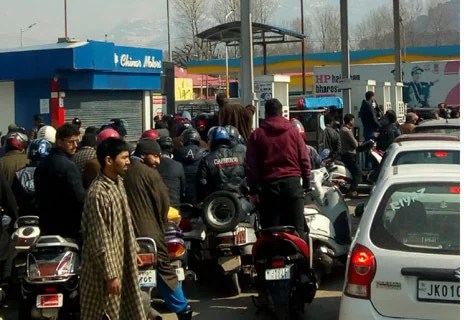
The fuel stations in Srinagar witnessed a surge of panicked motorists as the strike unfolded. Despite the anxiety among the public, the Divisional Commissioner assured citizens that there was an ample stock of fuel to meet the demand, aiming to allay fears of potential shortages.
The core contention revolves around Section 106(2) of the BNS, which prescribes a maximum ten-year imprisonment for cases of rash and negligent driving. A key government source clarified that if a driver promptly reports the accident to the police, they could face a lesser punishment of five years, as per Section 106(1).
Highlighting the rationale behind this provision, the government source emphasized instances where individuals, fearing retaliation from a crowd, flee the accident scene. In such cases, if the person moves away and calls the police, they may avoid harsher penalties under Section 106(2). This nuanced approach aims to strike a balance between accountability and safeguarding individuals from potential harm.
Citing Supreme Court directives, another government official underscored the importance of taking strict action against drivers who recklessly cause accidents resulting in fatalities. Immediate reporting to law enforcement, according to the amended Section 106(1) of the Sanhita, could lead to a reduced sentence of up to five years, with the offense being bailable.
Comparatively, the non-bailable Section 106(2) entails a potential sentence of zero to ten years for hit-and-run cases. The government’s efforts to distinguish between deliberate offenses and accidents caused by negligence underscore the evolving legal landscape.
The amended Section 106(1) specifies that individuals causing death through rash or negligent acts, not amounting to culpable homicide, could face imprisonment for up to five years and fines. Notably, medical practitioners performing procedures fall under this category, facing a maximum sentence of two years and fines.
This development marks a significant departure from the existing Indian Penal Code’s Section 304A, where the punishment for causing death by negligence is limited to two years of imprisonment and fines. The ongoing strike underscores the need for a careful examination of the balance between stringent legal measures and ensuring a fair and just legal framework for all stakeholders involved.