Lt Governor inaugurates JMC’s Material Recovery facility at Bandura
New facility equipped with latest technology based machinery for sustainable urban future; to achieve 100% recovery from the dry waste
We are adopting “Reduce, Reuse, Recycle” approach for minimization of accumulated waste: LG
Swachhta Kendras to act as a support system for waste aggregators & recyclers. To complement government’s efforts towards effective Solid Waste Management
Government making efforts through creative Waste Management Strategies for Environmental Sustainability, says the LG
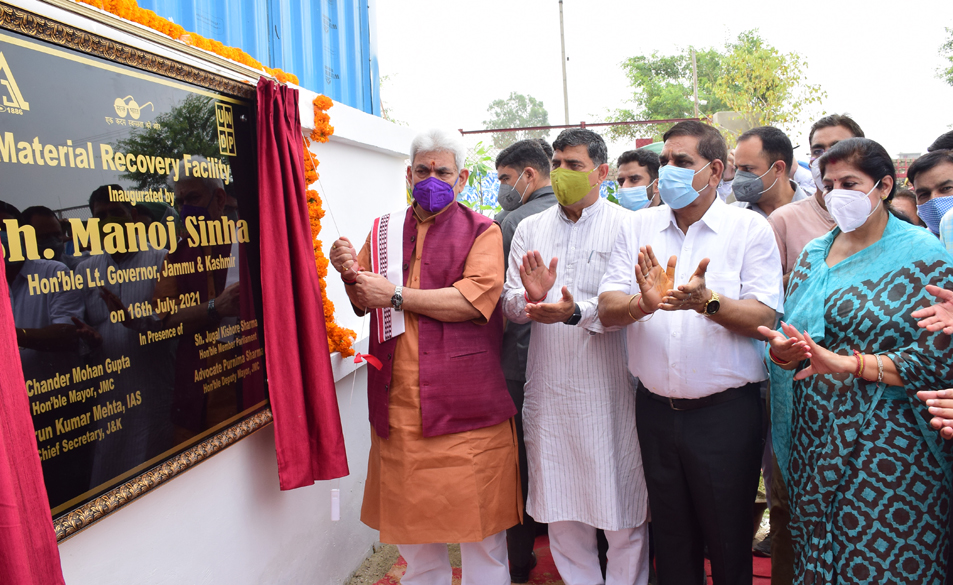
Press Trust of Kashmir |JAMMU: In a step aimed at better Solid Waste Management processes and environmental sustainability in the UT, and to facilitate easy segregation, disposal and processing of waste generated in Jammu city, Lieutenant Governor, Manoj Sinha today inaugurated the Material Recovery facility at Bandurakh, Jammu.
The new facility has been equipped with latest-technology based machinery for better efficiency to achieve 100% recovery from the dry waste. It will ease the collection and segregation of all kinds of paper waste, cardboard and plastic etc from day to day waste generated in the city.
Speaking on the occasion, the Lt Governor said that the new facility will complement the government’s efforts for effective Solid Waste Management, and will contribute towards Swachh Bharat Mission of J&K.
Government is giving focused attention towards Waste Management for a sustainable urban future in the UT. We are putting consistent efforts into formulation of creative Waste Management Strategies for environmental sustainability, besides making the protection and preservation of the environment an integral part of our development plan, said the Lt Government.
By adopting the 3Rs approach “Reduce, Reuse, Recycle”, we are minimizing the waste in a scientific manner so that our cities become more sustainable and clean, the Lt Governor remarked.
The concept of reducing the amount of waste generated by reducing consumption is essential to waste management. The reuse of items, or re-purposing them for a use different from what they are originally intended for is the next essential thing in the waste reduction hierarchy. The last stage of the waste hierarchy is to recycle. Recycling is the transformation of waste into raw material for manufacturing a new item. Thus, the 3Rs approach stands at the very top of the waste management hierarchy, he added.
Underscoring the key components of the Swachhta Kendra, the Lt Governor observed that the new facility will maximize the quantity of recyclables to be processed, while segregating materials that will generate the highest possible revenues from the recycling market. It will also help in segregating combustible fraction, non-recyclables and inert from the dry waste stream.
It was informed that the facility has been equipped with various features to make it an economically sustainable socio-technical model. Moreover, it will also act as a support system for capacity building of the waste pickers, waste aggregators, and associated recyclers.
Sh. Chander Mohan Gupta, Mayor, JMC said that the Jammu Municipal Corporation is taking several steps and initiatives to ensure implementation of effective solid waste collection, transportation and disposal practices in its jurisdiction.
It is pertinent to mention that recently, the Lt Governor laid the e-foundation of Rs 80 Crore worth Integrated Solid Waste Management facility at Kot-Bhalwal, in collaboration with NAFED.
Sh. Jugal Kishore Sharma, Member Parliament; Dr Arun Kumar Mehta, Chief Secretary; Sh. Dheeraj Gupta, Principal Secretary, H&UDD; Sh. Mukesh Singh, Additional DGP; Dr Raghav Langer, Divisional Commissioner, Jammu; Sh. Anshul Garg, Deputy Commissioner Jammu attended the inaugural ceremony.
Ms. Purnima Sharma, Deputy Mayor JMC; Ms. Avny Lavasa, Commissioner JMC; Sh. Rohit Khajuria, Vice-Chairman, Jammu Development Authority and other senior officers were also present on the occasion.
Also Read : Transit facilities, infrastructure, livelihood projects being initiated for tribal population: Dr Shahid
Press Trust of Kashmir | SRINAGAR : The government has initiated a slew of measures towards providing facilities to tribal migratory population with focus on infrastructure development, healthcare, livestock improvement, income generation and skill development based on ongoing survey.
Pertinently, plan formulation under Integrated Village Development Scheme has already been initiated for overall tribal development at village level.
This was informed by Secretary, Tribal Affairs, Dr Shahid Iqbal Choudhary, while chairing a meeting held here today to finalize plan for tribal welfare. The plan included income generating units, milk villages, sheep villages, livelihood programmes, establishment of transit facilities, support system for transhumant population, strengthening of veterinary healthcare, mobile clinics/ hospitals and related initiatives.
Directors Animal Husbandry and Sheep Husbandry departments, Jammu and Kashmir, Chief Animal Husbandry Officer and District Sheep Husbandry Officers besides others were present in the meeting.
Dr Shahid asked the departments to work in a coordinated manner towards finalization of locations being identified for construction of pre-fabricated transit accommodation on migratory routes, notification for selection of beneficiaries for income generating units and finalization of estimates. He discussed about flagship schemes, construction of veterinary healthcare infrastructure, mobile veterinary hospitals and other initiatives being launched by the tribal affairs department this year. He stressed on formulating project proposals for establishment of more than 2000 income generation units apart from livestock product management.
Director, Animal Husbandry Department, Kashmir, Purnima Mittal, proposed a common DPR for milk villages, requirement of mobile veterinary vans, inclusion of poultry farms under Milk Village Scheme apart from support for strengthening machinery and equipment in tribal areas.
Director, Sheep Husbandry Department, Kashmir, Bashir Ahmed Khan, emphasized projects including provision of tents at transhumant hamlets, mobile veterinary clinics, sheep villages, quality and value addition product support to tribal youth.
Director, Animal Husbandry Department, Jammu, Vivek Sharma, proposed 50% beneficiary share for IGUs to be supported by the department, addressing variation in costs, repair and upgradation of veterinary healthcare infrastructure in tribal areas among other projects.
Director, Sheep Husbandry Department, Jammu, Krishan Lal, proposed coverage of 1500 tribal families under transhumant hamlets, training of youth in rearing and value addition, construction of veterinary dispensaries, mobile clinics and income generating activities.
Director, Tribal Affairs Department, Musheer Mirza, underscored the need for working out convergence planning avenues with special focus on livestock development and infrastructure support for migratory population.
Joint Director, Planning, presented a resume of various proposed works to be implemented in coming days.
Secretary, Advisory Board, Mukhtar Choudhary, Joint Directors from concerned departments and others were also present in the meeting.-(PTK).