Chief Secretary delineates framework for reducing multidimensional poverty in J&K
Calls for district-specific action plans, targeted interventions to accelerate poverty reduction
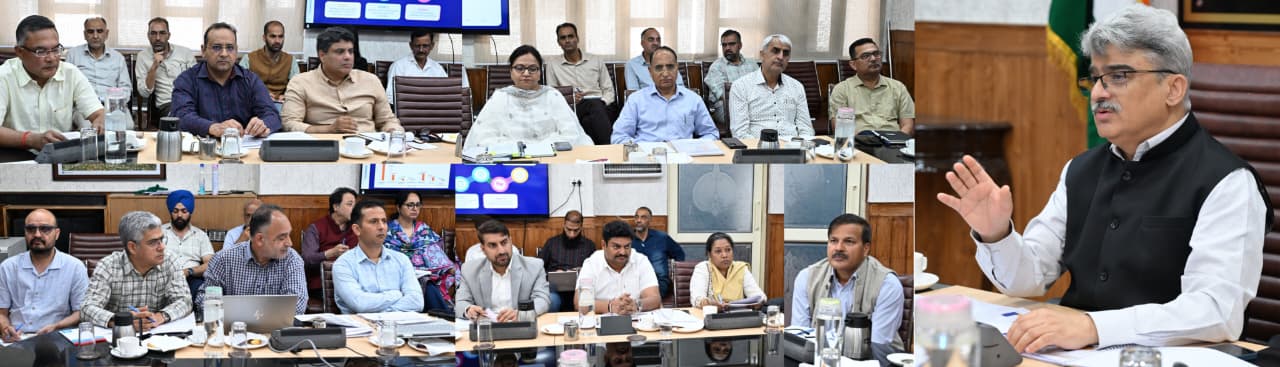
SRINAGAR, JUNE 17 (PTK): Chief Secretary Atal Dulloo today chaired a high-level review meeting to assess the current status of the Multidimensional Poverty Index (MPI) in Jammu and Kashmir and deliberated on targeted interventions required to further reduce poverty levels across the Union Territory.
The meeting was attended by the Additional Chief Secretaries of the Power Development and Finance Departments, Commissioner Secretaries of the Food, Civil Supplies and Consumer Affairs, Planning, Development and Monitoring, Health and Medical Education, and Social Welfare Departments, Secretary Rural Development Department, senior officers of the Planning Department, while Deputy Commissioners of all districts participated through video conferencing.
Reviewing the incidence of multidimensional poverty in Jammu and Kashmir and the indicators defining deprivation across the three dimensions of Health, Education and Standard of Living, the Chief Secretary stressed the need to identify vulnerable households in every district, with initial focus on Antyodaya Anna Yojana (AAY) beneficiaries, to facilitate targeted and outcome-based interventions.
He directed the Planning Department to undertake a comprehensive analysis of the updated data emerging from the forthcoming National Family Health Survey (NFHS-6) and prepare district-specific action plans aimed at improving key indicators and accelerating poverty reduction.
The Chief Secretary observed that several Centrally Sponsored Schemes already provide effective tools for addressing various dimensions of poverty. He highlighted flagship programmes such as the National Food Security Act, Ayushman Bharat, National Education Policy-2020 initiatives, housing schemes, Ujjwala Yojana and financial inclusion programmes as critical instruments for improving living standards and reducing deprivation.
He emphasized the need for convergence among these schemes and augmentation through capital expenditure wherever required.
Dulloo also instructed the Planning Department to develop a standardized survey format for district-level assessment of vulnerable households and work closely with district administrations to identify gaps and priority areas requiring focused interventions.
Additional Chief Secretary Finance, Shailendra Kumar, advised districts to incorporate poverty reduction initiatives into their annual development plans and stressed the importance of focusing on AAY households for more effective and targeted interventions.
Commissioner Secretary, Planning, Development and Monitoring Department, R. Alice Vaz, informed the meeting that the Multidimensional Poverty Index captures poverty beyond income and reflects deprivations experienced by households across multiple dimensions, making it an important policy tool for poverty eradication.
She said the current baseline MPI estimates are based on NFHS-5 data released in July 2023, while NFHS-6 is under finalization and is expected to provide updated insights into multidimensional poverty across the country.
The meeting was informed that the MPI framework comprises twelve indicators across three dimensions—Health, Education and Standard of Living—with equal weight assigned to each dimension.
Highlighting Jammu and Kashmir’s performance, officials informed the meeting that the Multidimensional Poverty Headcount Ratio declined significantly from 12.56 percent in 2015-16 to 4.80 percent during 2019-21. During this period, more than 10.45 lakh people moved out of multidimensional poverty, reflecting the positive impact of sustained welfare and development initiatives.
The meeting further noted that Jammu and Kashmir is well on course to achieve Sustainable Development Goal (SDG) Target 1.2, which aims to reduce multidimensional poverty by at least half before 2030. All twelve indicators used to measure multidimensional poverty have shown improvement.
Among the districts, Doda, Ramban, Rajouri, Poonch and Udhampur recorded the steepest declines in multidimensional poverty over the assessment period. Rural areas witnessed significant improvement, with multidimensional poverty declining from 16.37 percent to 6.10 percent, while urban poverty reduced from 3.51 percent to 1.09 percent.
The intensity of poverty also improved, declining from 44.17 percent to 42.11 percent, indicating better living standards and improved access to essential services.
Presenting district-wise analysis, officials informed the meeting that as per NFHS-5 estimates for 2019-21, nearly 6.39 lakh persons belonging to around 1.28 lakh families in Jammu and Kashmir were identified as living in multidimensional poverty, with the overall poverty headcount ratio standing at 4.80 percent.
Ramban recorded the highest Multidimensional Poverty Headcount Ratio at 14.86 percent, followed by Reasi (11.40 percent), Kishtwar (10.59 percent), Udhampur (10.23 percent) and Rajouri (8.07 percent), indicating the need for focused interventions in these districts.
Conversely, Jammu district registered the lowest poverty ratio at 0.49 percent, followed by Srinagar (1.34 percent), Shopian (1.54 percent), Pulwama (2.09 percent) and Samba (2.30 percent), reflecting significant improvements in socio-economic indicators.
In terms of absolute numbers, Baramulla accounted for the highest estimated multidimensionally poor population, followed by Udhampur, Rajouri, Kupwara and Ramban, highlighting the need for district-specific strategies to address both the incidence and intensity of poverty.
The meeting also reviewed the contribution of various government schemes towards reducing multidimensional poverty. Officials informed that a broad range of welfare and development programmes covering health, education, housing, livelihoods, social protection and financial inclusion have collectively contributed to improving living standards and reducing deprivation across Jammu and Kashmir.(PTK)